
How to Learn Growth Marketing
The goal of this guide is to create a step-by-step path to learn Growth Marketing and make life easier for anyone just getting started.


The goal of this guide is to create a step-by-step path to learn Growth Marketing and make life easier for anyone just getting started.
My motivation for writing it is simple: I had a really hard time finding high-quality knowledge when I was starting out in the field.
There's a lot of shallow material and clickbait out there.
Let me be clear: this is a curation of content that I consider high quality, with a clear order for your studies. It's not an exhaustive growth training program, but it gives you a solid base to start in the field.
But...
What is Growth Marketing? Or Hacking?
Growth Marketing, growth hacking or performance marketing is maximizing a company's revenue through the use of data.
Growth Hacking is just a buzzword used to refer to the same thing.
This is the definition from @julian, and it's the one I believe is most on point.
The difference between growth marketing and traditional marketing lies precisely in the precision with which we can measure our results.
Measuring the revenue lift a company gets from billboards is... an extremely difficult task.
Measuring the results of a Google ad may not be easy (Depending on how messy things are), but it's doable.
Another important distinction: growth marketing focuses on increasing a company's revenue, not on making people know your brand (Brand Awareness).
How to learn Growth Marketing?
Basically, to learn Growth, you have to understand the foundations of digital marketing and the foundations of the data analysis and experimentation process.
So you need to know how to operate a marketing funnel (acquisition, conversion, engagement, revenue and referral), and be able to experiment with it consistently.
All of this gets much easier if you're a technical person, but that's not required.
There are countless tools that make your life easier on that front.
Growth Team vs Growth Professional
A lot of people say it's impossible for there to be a growth professional, or a growth hacker 🤢, who concentrates all the skills needed to run this process on their own.
I disagree. @ryanckulp (FOMO) is a living example of someone who does the whole process, start to finish; @levelsio is another;
I'm sure you'll find endless examples of people who bring together enough skills to build and grow a business on their own, but that's not necessarily how it has to be.
With a team, things get simpler, since you can distribute the process and make it more accessible.
What matters is that it contains all the essential components, which translate into key skills:
- User acquisition and conversion
- Product development
- Continuous experimentation
This guide sets out to cover User acquisition and conversion, and Continuous experimentation.
Learning about user acquisition and conversion
These are the skills you develop over a digital marketing career.
User Acquisition
SEO, SEM, Social Media, Influencer Marketing, Viral Marketing, Social Ads, among many others, are examples of user acquisition channels.
When the book Traction was written, the authors listed 19 traction channels for acquiring customers.
Today, some people already talk about 21 channels.
My recommendation is the following:
- Get to know all the channels. You can do that by reading the book Traction, or read this post where Vinicius Camilo summarizes that information.
- Learn to operate, at least at a basic level, the paid channels on Google and Facebook
- To learn the others, experiment in an orderly fashion, using the Bull's Eye Framework, with the other channels.
- You'll have more skill/affinity executing certain specific channels. Specialize in them.
Learning to operate paid channels is important because they tend to be the easiest to test, and they also validate other channels.
If Google Ads works for you, SEO should work too.
If Instagram Ads work, both Social Media Marketing and Influencers should work as well.
And you can validate these channels in a week or two (for most businesses).
Here's a list of the available channels:
(If you have a good intro link for any of these channels, send me an @ on Twitter or an email.)
- Influencers
- Public Relations
- Unconventional Public Relations
- Google Ads
- Social media ads
- Offline Ads
- SEO
- Content Marketing
- Engineering as Marketing
- Partnerships
- Sales
- Affiliate Programs and Channels
- Other Platforms
- Fairs and Trade Shows
- Offline Events
- Speaking Engagements
- Community Building
- Email marketing
- Viral Marketing
User Conversion:
This tends to be the first bottleneck for anyone learning marketing.
We often focus a lot on how to operate a channel, but forget a few things that apply to all of them: persuasive language, clarity about the next step, and sales arguments;
That's why these skills are essential for a sales professional/team.
Without them, you won't be able to generate leads to make your sales, let alone move those leads down the funnel.
So the next step is learning how to
- Write one hell of a text with Copywriting
- Optimize Landing Page Design with CRO
- Design a sales process
Be a unicorn: pick your Marketing Stack
Now that you have a sense of the whole process, you can choose a marketing stack to specialize in.
A programmer refers to their "stack" basically as the universe of programming languages/skills they operate fluently and get good results with.
Bringing that analogy to Marketing, we can think of a marketer's "Stack" as the universe of channels they specialize in and are most proficient at.
For example:
- Paid Media
- Landing Page Design and Copywriting
- Email marketing
This Marketing "stack" guarantees you can run the whole marketing process in a specific way:
- attract users using paid media,
- convert users using copywriting and well-built landing pages,
- make a sale (another conversion) using your email marketing skills.
Another possible stack:
- SEO
- Content Marketing
- Email Marketing
With this Stack, you specialize in attracting users organically to make a sale.
There are countless ways to combine these skills and the operation of the 19 traction channels.
The more unique your stack, the more valuable your marketing skills will be.
Up to the point where you become a unicorn. A professional so unique and valuable they're almost impossible to find!
Think about it:
- how many professionals specializing in paid media are there in Brazil? 20 thousand?
- how many paid media specialists are also great landing page designers? 1 thousand?
- how many paid media specialists are great landing page designers and know how to build an email funnel that generates sales? 100?
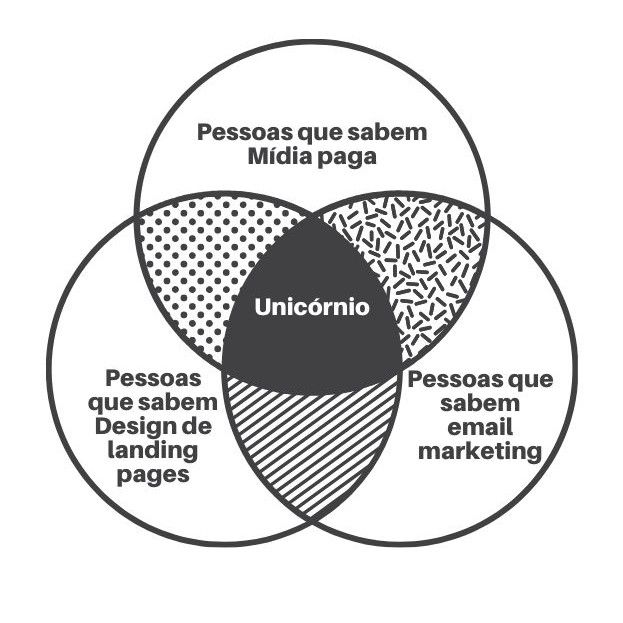
The idea behind this line of thinking is the following:
- Past a certain level of specialization, your marginal optimization gains shrink. Returns are diminishing.
For example:
There comes a point, when optimizing an ad account where all the best practices are in place, where you've already hit 95% "account optimization*".
Tweaking the account structure, keywords, ads, and so on will only bring small gains.
You can go from 95% to 98%.
That corresponds to a 3.17% improvement in the final result.
But if your landing page is sitting at an "optimization index*" of 40%, for example.
Optimizing it to 80% will double your final result.
* Think of this as an arbitrary variable that defines a channel's optimization level. It's not meant to be taken literally.
That's why having at least 3 key skills multiplies your chances of getting good marketing results, and why you should pick a broader stack than usual.
Testing like a pro: continuous experimentation
To apply the tactics described here, you'll need to be really good at running tests.
The goal here is to run relevant tests at the highest possible speed, on a regular basis.
You need to know how to prioritize your tests effectively to pull this off. To do that, let's start by understanding the two types of test that exist:
- Channel Tests (exploration)
- A/B Tests (optimization)
Shall we start with the simpler one?
What is an A/B test?
An A/B test is an Optimization test;
It's used when you already have results from a landing page, media, creative, whatever - and you want to improve them.
To do that, you'll use the Split Testing method: you'll show the original version (control) and a new version of whatever is being tested to the same number of random visitors, and measure the impact on your goal.
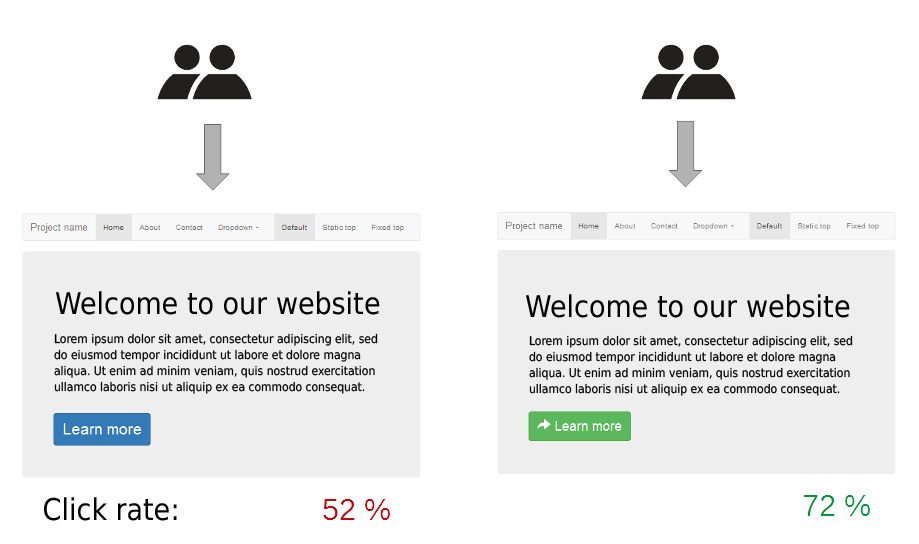
A good starting point to learn how to run an A/B test is this case study we did at Traktor.
One important thing: you should only start running A/B tests once you have baselines to test against.
In other words, there's no point A/B testing everything until you have significant traffic. It will simply take way too long, and you won't conclude anything.
To run an A/B test, you should do the following:
- Run a diagnosis to identify the main improvement opportunities:
Sean Ellis's Product/Market Fit survey
Google AnalyticsHotjarMixpanelHeap
- Prioritize one point to be specifically addressed by tests;
- Define the goal of the test
- Define the hypotheses to be tested
- Define the method for tracking results
- Collect and analyze results
- Record the lessons learned
Know your way around spreadsheets (Google Sheets, Excel, Open Office, etc.). If you can pull data from a database with a bit of SQL, that's a nice plus;
You can use this A/B test tracking Spreadsheet to keep track of your test results.
What is a channel test?
A channel test is an exploration test;
You're exploring a new acquisition channel when you run this kind of test.
By definition, running this kind of test is a much more elastic task than an A/B test;
You don't have a defined baseline, you may have never operated that channel, and your results will vary a lot.
As you already know, there are 19 (or 21) channels to be tested, and to get through testing them, you have to prioritize.
Here's a Channel Test Prioritization and Tracking Spreadsheet using the Bull's Eye Framework;
The process goes like this:
- Understand all the available channels and brainstorm how they could be used;
- Prioritize the tests by Cost, Effort, Impact, and Lead Quality (see the spreadsheet);
- Define the three channels to be tested over the next X period of time (it depends on the channel - ads usually show results within a month, content marketing and SEO take much longer)
- Record the results, and interpret them;
Once you have enough information to decide whether a channel works, you can start focusing on it.